Examples
Real surfaces built from the system, as visual reference.
Examples show the rules in use. They aren't rules and carry no status: where one differs from the guidance, the guidance wins. In this first pass each opens where the surface lives today.
screamingface.ai home page
The public home page: the headline, the proof card, three ways in, the mission and the newsletter. The reference for approved copy.
Leaderboard
The leaderboard's versions in one place: the live portal, the v2 replica and the scoreboard. Open one for the board itself.
Leaderboard MVP
Fusions ranked per benchmark by accuracy and run cost, split into reproducible and unverified results, with a cost-versus-accuracy Pareto frontier. On mock data. The closest reference for a board or a dashboard of results.
Scoreboard
Public benchmark results with accuracy, providers, verification status and local rerun links, re-skinned onto the system.
Landing page studies
Six landing page layouts built on the system.
Model Ensemble Studio
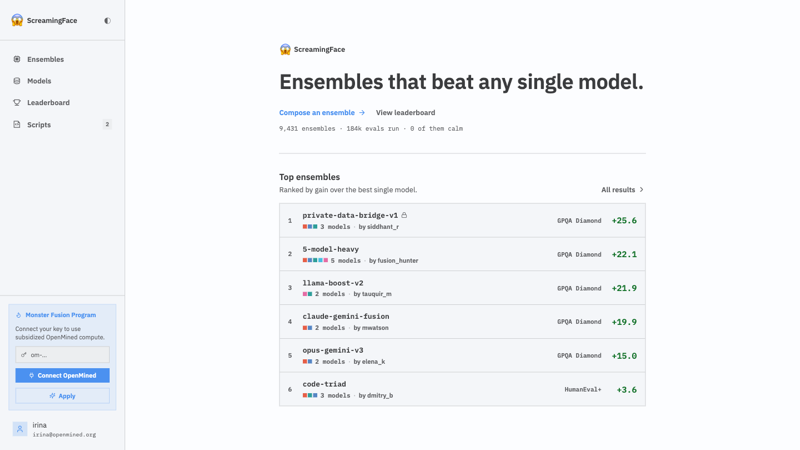
Compose fusions, browse models, run scripts, submit to the board. The desktop app re-skinned onto the system: a full app shell on the product register, light and dark.
SDK notebook widgets
The SDK widgets as they render in a notebook.
Link preview card
The 1200 × 630 link preview card.
X cover options
Cover image options for the X profile.
Fusion ground
The fusion gradient as a moving ground, as embedded on a surface.
examples
Components, composed — the assemblies teams actually ship, rendered live from the classes above. Copy the markup; every part is a real system class, so an example here doubles as an integration test the same way the registry does.
.chart-card + .th-sort + .score-cellproduct
.th-sort; the benchmark switch is a .field.dd
view markup
.chart-card + --data-*product
view markup
The other social surfaces live with the identity assets:
the X cover source (add ?guides for the display hazards) ·
the OG / social card · the profile image.
surfaces
Where the system lands: the real products, re-skinned onto SFDS. Every card opens the live, interactive thing — not a screenshot.
- two registers
- surfaces split by audience — a public register (marketing energy: the leaderboard, the scoreboard) and a technical register (denser, tool-like: the studio). Same tokens, different voice.
- proof surface
- each surface is an acceptance test for the tokens — re-skinned in place, still fully interactive; if it holds up here, the system holds
- round-trip
- when a surface needs a value the system doesn't have, the fix goes into the tokens or components, never a one-off (the verified pill + data-table earned their way in this way)
- one story color
- gold is rationed to the win — the leading row, the SOTA counter; green marks verified/reproduced; blue is interaction. The three never compete.
Live today: screamingface.ai (leaderboard) · scoreboard.screamingface.ai (receipts) ·
this guide. Next onto the system: the studio (research client) and the docs site.
 public · iterating
screamingface.ai
The landing — now an iteration hub with six slots. Every version in one place on the live SFDS: the SFDS-v1 direction, the apex that's live today, the earlier full draft, Irina's React prototype, and two open slots for what's next. One wins, then ships. open the versions →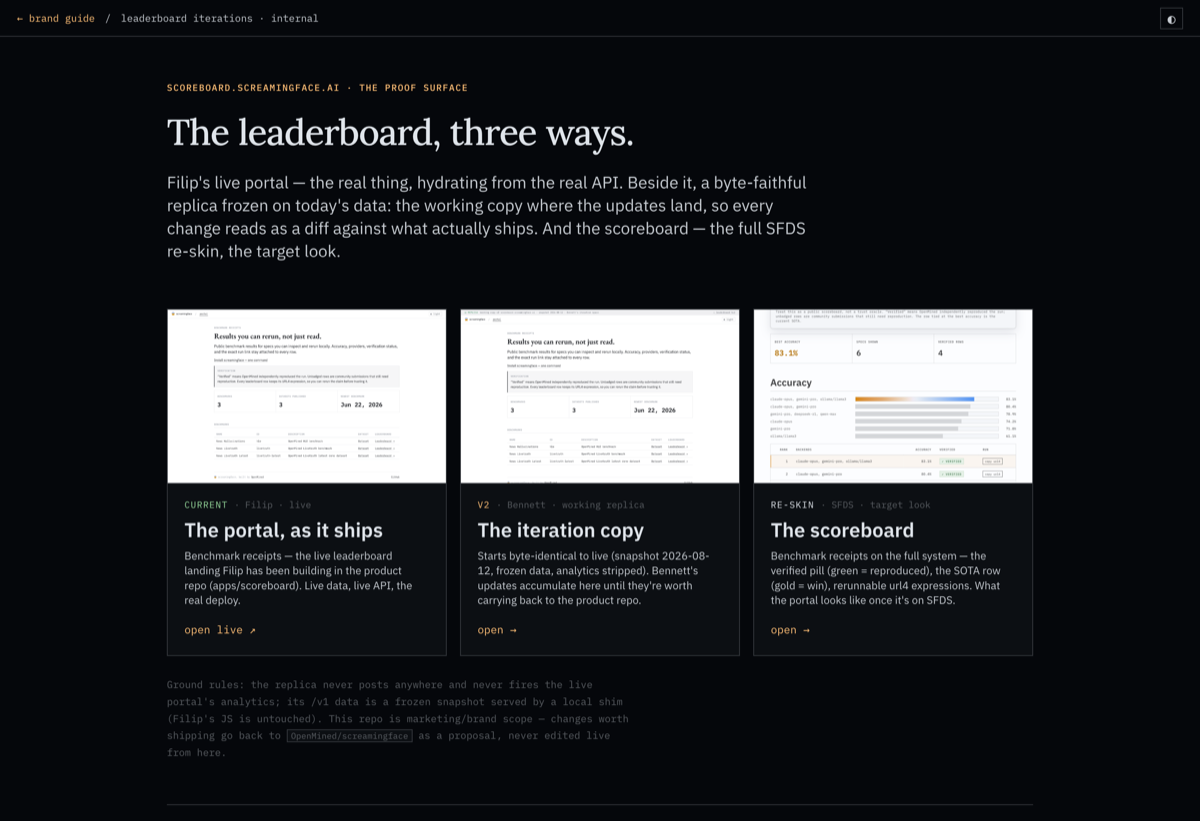 public · iterating
the leaderboard
The proof surface, three ways: Filip's live portal (the real deploy, real API), the byte-faithful v2 replica on frozen data where the next round of updates lands, and the scoreboard — the full SFDS re-skin showing the portal on the system. open the versions →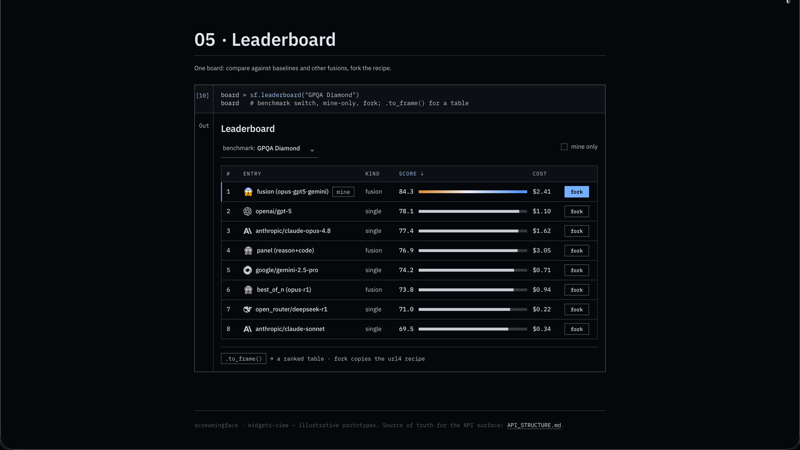 notebook · spec
the SDK widgets
The programmatic front door — ten interactivescreamingface notebook widgets (setup, browse, compose, run, leaderboard) framed as live cells. The technical register in Jupyter/Colab; the target look & behavior for eng.
open →
 desktop · live
the studio
Model Ensemble Studio — compose fusions, browse models, run scripts, submit to the board. Full app shell on the product register, light and dark. open →the universe
The cast of ScreamingFace — the makers, the fusions they build, and the scenes between them. The world that grows out of the icon lives on its own page.